
I have had a number of clients concerned that their dog or cat eats grass sometimes on a daily basis and they are concerned that there is something wrong with their pet.
Often, they tell me that it they think it is to make their dog or cat sick and they see evidence of the undigested grass either in their pet’s vomit or the other end when they pick up their dog’s poo on a walk.

I take Ruff out every morning and watch him eat the dew off the grass and the long blades of grass almost every morning – he loves grazing like a cow!
There are two main types of canine grass eating. The first is simple grazing where your dog happily munches on grass and suffers no ill effects.
Sometimes it may be to make up for a nutritional deficiency but even dogs that eat well balanced diets will eat grass. It’s possible that they simply like the taste and the sensation. It’s like a fresh salad to them. So even if you’re feeding your dog well, they might still fancy some greens!
Instinctive vomitting behaviour
The other type of grass eating is when a dog eats some grass and throws it up. This is thought to be a deliberate instinctive attempt to induce vomiting after they’ve swallowed something that makes them feel ill or disagrees with them.
Dogs that eat to make themselves vomit usually swallow grass as quickly as possible, barely even chewing it. It is believed that the long, unchewed pieces of grass stimulate their throats to bring on the vomiting reaction.
If your dog eats grass then vomits and seems fine, they have probably instictively taken care of whatever their intolerance was.
Parasites could be another reason
A team at the University of California, Davis, School of Veterinary Medicine believe that regular plant eating by our pets is a reflection of an innate predisposition of regular plant eating by wild ancestors, which is supported by numerous reports of wild carnivores eating plants, as shown mostly by the non-digestible grass and other plant parts seen in their scats (the researchers name for poo!)
Studies on primates have revealed non-digestible plants purge the intestinal system of worms and other parasites.
Given virtually all wild carnivores carry an intestinal parasite load, regular, instinctive plant eating would have an adaptive role in maintaining a tolerable intestinal parasite load, whether or not the animal senses the parasites.
The findings were presented at the annual Congress of the International Society for Applied Ethology in Bergen, Norway.
As reported in the journal Science, the team’s advice is to buy or grow some indoor grass for cats to chew on. This will give them a chance to exercise this innate behaviour with a safe source of non-poisonous plant life.
I happily allow Ruff to be a cow-dog and fulfil his ancestral instincts on our morning walks even though he is regularly wormed😊


Moopy and his anal glands!
Anal gland problems are very common and can be very distressing if not treated correctly
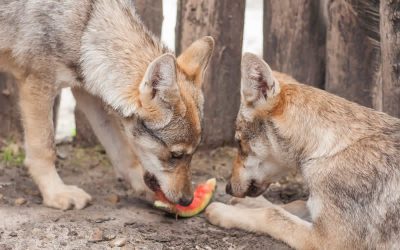
Wolves in zoos are fed dog food
Wolves are not picky eaters nor are they pure carnivores as the meat-based dog food companies want us to believe

Do we need to worry about DCM with a legume rich diet?
DCM or dilated cardiomyopathy is one of the biggest concerns to most owners feeding their dogs a 100% plant-based diet
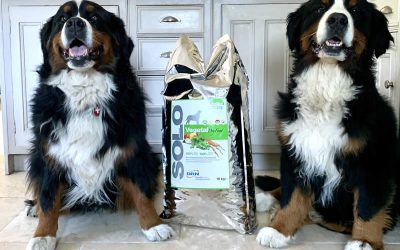
Bruno and Ruby are thrilled that we now sell 10kg Solo Vegetal!
We are so excited to announce that we now stock big shiny 10kg Solo Vegetal bags!
Facing our fears
I feel compelled to write this very personal post to you as I feel in such a safe space with you all! Through veganism and a mutual love of our pets, I have 'met' and continue to meet and bond with you - the most wonderful warm and caring community that one could...

Cancer and plant-based dogs
We asked the top vet oncologist in the country for her opinion on whether a vegan diet could protect our dogs from cancer

We feature on BBC Live!
The more we feature and spread our message, the greater the impact we will have with promoting the healthiest and certainly the kindest way to feed our pets today and in the future!

Raw dog food ‘may be fuelling spread of antibiotic-resistant bacteria’
Researchers found that all of the raw dog food samples contained antibiotic-resistant Enterococci, including bacteria resistant to the last-resort antibiotic linezolid

We feature in the August Issue of Vegan Life
She has written the article with such an in-depth understanding of the importance of dogs going plant-based – all just so positive for the future!

The Vit D3 and Vegan Dog Food Debate
Which dog foods in the UK can be classed as fully vegan?

Mother nature is crying out….and we are listening!
“I don’t think we are going to become extinct. We are very clever and very resourceful”
How much oil should you feed your dog?
Something that so many owners who transition to plant-based notice with their dogs – how soft the fur becomes!